Showing posts with label meeting notes. Show all posts

Monday, October 28, 2019

Notes from Saturday


TAPT,

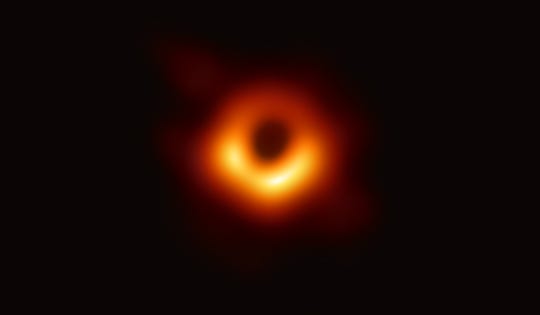
We had a great talk last Saturday at our annual U of A breakfast. Many thanks to Dr. Sam Gralla for a fascinating talk, and for introducing us to the subtleties of imaging a black hole. Thanks also to the U of A Physics Department for a delicious breakfast
Telescopes captured the first picture of a black hole.
In the talk, we learned a lot about the black hole in our galaxy and in others, especially the one in M87, which was the source of the image. Also discussed: the jet from M87, interferometry, radiation from black holes. There was a fascinating discussion of what the constructed image that was released last spring may represent, as well as what it probably doesn’t represent. We also got a sense of how much coordination and cooperation was necessary to make this extraordinary image, and also the best way to transfer terabytes of data between observatories (hint: it’s not by having a good wifi or data connection.) Dr. Grall graciously answered all questions. He also offered to share his slides, and I think I will be able to send those along soon. Thanks to everyone for coming.

Also, Fritz brought two books:
Deep Medicine: Artificial Intelligence Can make Healthcare Human Again, by Eric Topol et al.

and Something Deeply Hidden: Quantum Worlds and the Emergence of Spacetime, by Sean Carroll, whom Fritz called a “great explainer.” Both highly recommended.

Please join us for our next meeting on November 9th at J.D. Garcia’s house, with our usual format. We’ll meet at 9:00 at J.D.’s for potluck breakfast. The topic is energy. We will discuss the latest representations of energy here and in the UK, as well as when and how different instructors work it into the curriculum. Please bring your favorite demo, extra credit if it is energy-related.

Hope to see you all there.

Best,
Karie

Sunday, January 27, 2019

Meeting Notes


TAPT,

We had a fantastic and sort of nostalgic meeting last week – actually now that I look at the date it’s been two weeks. Erik Herman, former Tucsonan and founder of the Physics Factory bus, visited from Ithaca NY. He has been working as outreach coordinator for Cornell University, but is planning to go fulltime as an informal science educator. He was here to help Bruce Bayly and friends to outfit the newest Physics Bus, which seems to be bus #7. Also attending was Damien, a student who works on the bus.

The bus is small and sweet - it's the size of one of those smaller school buses that would hold about 30 students. It was purchased by funds donated by Barbara Bickel, and she was at the meeting to see the it. Bruce is planning to have undergrads drive, so the smaller size is best for that. But it had a lot of cool stuff on it: lots of wave and sound demos. One cool demo/experiment used neon bulbs in a microwave to measure the approximate wavelength of the microwaves. The bulbs are available on eBay – mine came this week. According to Al Vanuga, you can also use a compact fluorescent bulb if you put the metal part in water.

Erik’s bus in Ithaca runs on solar power. US Battery has donated some great batteries to make that possible, and they want to donate more.

One interesting discussion was about a Freakonomics podcast about supply and demand. There is a huge supply of education, but less demand. Especially science education, where there are a lot of people writing curriculum etc. Bruce and Erik see the bus as a way to increase demand for science education.

At the meeting, Fritz showed us two magazines, but I unfortunately only wrote down one: PRISM magazine, which had an article he liked on bees, and only one about cameras run by a Raspberry Pi. There was also a book: She Has Her Mother’s Laugh, by Zimmer. This is a history of the concept of heredity; it’s much more complex than we think. There is also some discussion of eugenics, which was/is bad. Fritz highly recommends this book. Also, one of Fritz’s friends invented the modem. 

In a previous meeting, we also discussed Deep Learninbg Revolution by Terrence Sejnowski. The takeaway is that people are bad at learning rules but good at spotting patterns. There was some discussion of thinking in the diffuse mode, which kind of uses the whole brain. Also, Helen pointed out that research shows that we are good at physics because we know physics. In other words, there’s not really a way to improve critical thinking without a subject matter application. I have actually been motivating my classes by using this line – you can do well at physics by learning physics.

Some dates for future meetings: 

Jim Housley will be in town for our next meeting, which is set for February 9th. Jim is planning to bring a suitcase full of equipment – if you have requests, send them to Jim at jmhousley@aol.com. Yep, he still has an aol address. In addition, I’d like to have a dinner for Jim and Karen that evening. Please put it on your calendar.

On March 2nd, the Arizona chapter of the AAPT will be meeting in Tucson at the Air and Space Museum. It should be great. I hope many from Tucson will attend – the main idea of moving the meeting to different regions of the state is to make it convenient for everyone at least occasionally.

Our April meeting is a bit up in the air, but will likely be April 13th at Pima Community College, as JD is not available on that day.

Our end of the year party will be May 18th, also subject to adjustment.

Hope to see you all in February. Let me know if you have questions/comments/suggestions.

Best,
Karie

Wednesday, April 4, 2018

Last Meeting's Notes and Upcoming AzAAPT

TAPT,

I haven't been too successful in selling AzAAPT meetings to the Tucson crowd, but they are always interesting. There are some great physics teachers in Phoenix and surrounding areas, and I always learn a lot. My husband and I are driving up Friday night, and could take a rider. I copied Jim Ward's email below, so take a look, I think it will be a good meeting, and you can see Lowell Observatory as a side trip. I spent many nights there in my youth.

TAPT meets the following Saturday, April 14th. We have a speaker, thanks to J.D. Her name is Dr. Elena Plante, and she will be talking about language and learning. I'll have more information soon. 

Our meeting last Saturday (March 24) was great - Fritz knows so much! We talked about the book Learn Better, and I did distribute Fritz's notes for your perusal. Some of the highlights:
  • How people learn to do math on an abacus is different than on paper, and apparently better. Something about a physical connection association with the processes. One Irish philosopher thinks the hand is part of the mind.
  • Fritz thinks there is something missing in the theory of cognition, something that has to do with energy - energy is part of learning and gestures are part of that.
  • A positive attitude toward math makes people do better at math. Maybe that's what good parents provide.
  • Steve Jobs trained himself not to give feedback - he didn't even blink!
  • Good decisions take energy. Parole board clemency decreases right before lunch.
  • If students get in the habit of working, they use less energy to make themselves do it and have more left over for cognition
  • Poverty is noisy.
At our April meeting, I think we should have a discussion about Pam Tautz's "flashy thing", that piece of equipment that makes a motion map on students' phones. Pam, can you bring some cost estimates?

Thanks as usual to all who attended. 

Hope to see you one of the next two Saturdays!

Best,

Karie

Sunday, February 11, 2018

Last Meeting's Notes

TAPT-ers,

Just a quick re-cap of our meeting last week. Many thanks to Jim Housley for a great program and for bringing a lot of great stuff. Most equipment was snapped up. I have a few things if you would like them – a density set, and a dial indicator with an attached bracket and metal bar for set-up.

Among the demos Jim showed:

·      A float and chain engineering set – I hadn’t seen this before and they were all snapped up, so I’m not sure what all was included. It’s an engineering apparatus that asks students to develop different measuring devices – it’s super cool.

·      The dial indicators that we’ve seen before. Jim had a great idea for a lab – do a Hooke’s law experiment with the unit of mass being one student mass. The dial indicator can be on the floor, then one student at a time move to the indicator. As more students get close, the indicator shows more floor depression, and that can be turned into a displacement of the spring inside to graph an F vs x line whose slope is the spring constant.  We tried it on J.D.’s floor using teacher mass as the independent variable, but his floor is just too solid. Jim says it works well on any floor except the ground floor. The dial indicator can measure depressions or changes of 1/1000 of an inch.

·      A UV filter kit: one lens filters UV, one doesn’t. Everything looks the same until you have something that is fluorescing – best used outside. This has lots of potential in chemistry and physics. Jim had some UV beads that fluoresce in the sun.

·      Some beads that Jim bought at the bead show. These were beautiful. They look sky blue when the light source is off to the side, and reddish-yellow when you look through them at a light source. Just like the atmosphere. Jim surmised that there are small particles embedded in the plastic that scatter light.


Our next meeting is March 17th. J.D. is working on a speaker. Also, in April (our tentative date is April 14th) we are discussing the book Learn Better, by Ulrich Boser. I have several more copies of the book, thanks to Fritz Fisher. Let me know if you need one, I can send it through the mail. I will bring them to our March meeting too. I’ll also bring extra equipment from Jim.

Hope to see you all soon.

Best,

Karie

Sunday, October 15, 2017

Meeting Notes and Next Meeting

Tucson-Area Physics Teachers,

We has a fantastic meeting Saturday! Thanks to all who attended. 

Many, many thanks to our wonderful and gracious speaker, Dr. Brenda Frye. She was mesmerizing, and we not only learned a lot, but were basically entranced by the subject and the presentation.  Dr. Frye is an astronomer at Steward Observatory and an Assistant Professor in the Astronomy Department. Her enthusiasm for her research and for science in general is infectious! 

Dr. Frye talked about gravitational lensing and how she and others have used it to map dark matter. There were also some wonderful stories about the difficulty of doing science, for example, during WWI when communication between Germany and England was forbidden, and Einstein was in Germany and Eddington was in England. Some other threads concerned Vera Rubin, the first to notice rotation curves that led to the idea of dark matter - what an admirable scientist she was! Also Dr. Frye discussed some future Citizen Science possibilities. She ended her talk with the question, what is a galaxy? Her answer basically exploded everyone’s mind. There are some very deep mysteries, and a big reason is the presence of dark matter. She made the point that we know less about dark matter now than we did 10 years ago. It was fascinating!

Also, there was an amazing breakfast, sponsored by the U of A Physics Department and planned by J.D. Thanks to both!  We also had an attendee from Phoenix: Jim Ward, who has served for the last few years as the President of the Arizona section of AAPT. AzAAPT had a great meeting in Phoenix last week, Sept 30th. The AzAAPT's next meeting (next April) is planned for Bearizona, near Flagstaff. I am attaching Jim's report from the September meeting, in case you want details. It was a really good all-day meeting - lots of great information, and I'd love it if more Tucson teachers got involved.

Our next TAPT meeting is November 11th; it is tentatively scheduled to be at Pima Community College West Campus. We’ll have a free-for-all discussion about scheduling your class: how to cover everything you need to cover, how to fit in all the subjects, how deep to go, when to do lab and when to go deeper, how to know if your students know enough for you to move on. It will be relevant to AP as well as regular physics and college physics. Helen Reynolds, TAPT member and British physics teacher extraordinaire, will be leading the discussion, but I think it will be a discussion among everyone. Helen has several books in publication, and she will be telling us about one in particular that she uses for a one-year curriculum. Recert hours are available. More info to follow.

I hope your year is going great! Thanks for participating in TAPT - I hope it's helpful and enriching. I hope to see everyone at the next meeting. Please email me if you have any questions.

Best,

Friday, January 20, 2017

Meeting Notes and Upcoming Dates

TAPT-ers,

We had a bunch of delicious food at our start-of-the-year meeting. Scones, muffins, cinnamon rolls – apparently no one has started their New Year diet yet.

Bruce Bayly was only one of the Brits attending. (Helen Reynolds has recently joined the teaching staff of Greenfields.) Sorry for the digression, I meant to remind everyone that Bruce has arranged for Calculus, the Musical! to be presented here next Friday, January 27, 2017. I’ll attach the flyer, or go to www.eventbrite.com/e/calculus-the-musical-tickets-30503889956 for tickets.

We had a super interesting demo by Chris Ubing. He used his I/O lab device to measure the magnetic field of a current-carrying wire. He showed how to get the 1/r dependence using loggerPro or excel graphing of B vs r.
J.D. had three things to report – he has recently submitted questions for the physics GRE, he has been interviewing Flinn scholarship applicants – quite a task since there are many and they are all outstanding – and he gave a talk on The Role of Time in Science and Religion, which we want him to reprise for TAPT.

Fritz brought a lot of books, and they might have a theme that he is very interested in, which is AI, the new electricity according to Fritz, meaning AI is as revolutionary as electricity was:
Why Information Grows, by Cesar Hidalgo. Economic growth can be treated like natural systems
The Dreams that Stuff Is Made Of, by Steven Hawking, a collection of papers or readings about modern physics.
By Michael Lewis, The Undoing Project about Daniel Kahneman and Amos Tverskyan and how they collaborated on decision theory.
Zen Flesh Zen Bones, a “collection of primary Zen sources” according to Amazon.
Lenin’s Tomb, by David Remick (historical)
The Master Algorithm:How the Quest for the Ultimate Learning Machine Will Remake Our Worldby Pedro Domingos. I guess this is the fascinating AI book mentioned at the beginning.

Steve Hoell gave a nice demo about a battery in a spring – it zips through. He found it in the January 2016 AJP I think. I’m going to try to attach a video.

Future dates:
Our next meeting is February 4th, and our friend Jim Housley will be here with some equipment. Maybe bring a bag – I know he won’t want to take it back with him.

On March 4th we will have a meeting about preparing students for the AP exams. I’m a long-time AP grader and will talk about the new exams and give some hints.

Then April 8th is the AzAAPT meeting, which will be held at the U of A in the Physics and Atmospherics building (PAS). We are working on a speaker.

We are planning our end-of-year party on May 13th, and will be twisting J.D.’s arm to talk about time in science and religion.

If you are of a mind to drive, the second annual un-conference of STEMteachersPHX is January 28, from 10 am to 1 pm at Pinnacle High School in Phoenix. I know it's far, but this is a great group. Registration is free at: https://www.eventbrite.com/e/2nd-annual-unconference-tickets-30424058177
Recertification hours are available for all meetings – I try to remember to bring forms, but an advance email is helpful.
Hope to see everyone on February 4th.

Karie
Karie Meyers, Ph.D.
Physics Instructor and Chair, Physics and Geosciences Department
Pima Community College West Campus
phone: 206-6695
office: E230
email: kameyers1@pima.edu

Friday, October 28, 2016

Notes form Last Meeting

Our meeting Saturday was lots of fun for me, and we had some great discussion about the efficacy of group quizzes and two-part tests. If you would like information about the group quizzes, or the IF-ATs (immediate feedback assessment technique, http://www.epsteineducation.com/home/about/), please email me.  (Also, someone left a coffee travel mug – you can pick it up at J.D.’s [you can use the contact form on this blog and we'll put you in touch with J.D.]

Our next meeting is November 19 at Pima Community College West Campus. It will be in our new physics lab. Chien-Wei Han and his colleague Jorge will lead us in a workshop on Arduinos in the classroom. You can buy an Arduino on Amazon for $25 or so, or a kit for $80 or so, and Chien-Wei will have some for us to use if you don’t want to buy or bring your own.

We are thinking of subjects for future meetings. Some suggestions are : using online physics sites; improving your students’ AP scores;  group dynamics; CASTLE workshop; using Mathematica in your class; Video physics labs; using google docs etc.; making a solar oven; using VPython with your students. You are welcome to send more suggestions.

I hope members of our group will volunteer for some of these topics, or maybe you have a topic you are dying to share with the group. I’m trying to focus more on professional development for our group, and would love to hear your ideas.

Fritz’s books:

The Now, by Robert Muller, author of Physics for Future Presidents)  It’s about time. And the creation of time.
Our Mathematical Universe, by Tegmark
Computer Age Statistical Inference: Algorithms, Evidence, and Data Science (Institute of Mathematical Statistics Monographs) by Bradley Ephron and Trevor Hastie
The Master Algorithm, by Pedro Domingos

These last two books are about Artificial Intelligence, a subject about which Fritz knows a lot. In fact, he might give a presentation on it.

Other news:
There is a Math Teacher’s Circle. They meet once a month or so to investigate an interesting math topic. If you would like to sign up, go to https://goo.gl/forms/QvUrwBu7hgxIy7aE2.  More information at http://ime.math.arizona.edu/ttc/.

Thanks,

Karie

Tuesday, August 23, 2016

Saturday's Meeting Notes

TAPT,

We had delicious baked goods at our last meeting and we decided on a format of some talks and some workshops for this semesters’ program. Here are some dates we plan to meet this semester:

September 17th: This will be our Kick-off breakfast, kindly sponsored by the U of A Physics Department. J.D. is working on a speaker, possibly in the area of the neuroscience of learning. We’ll meet for breakfast in the PAS building.

October 22nd: Chris Ubing will teach a workshop on using Mathematica as a teaching tool. The workshop will be at Pima Community College West Campus, 8:30 – 11:00. Recertification hours will be available.

November 19th: Another workshop is planned. Depending on leader availability, topic will be Using Arduinos, or Physics websites update. More details to follow.

December 10th: Planning meeting/holiday cheer at J.D.’s house. Breakfast potluck with a holiday theme. At this meeting we will decide on more workshops and activities for the spring semester.

Also please note: the AZAAPT meets September 24th in Phoenix. Details to follow.
We had a lot of ideas for workshops, and those given above sort of floated to the top through a combination of people available and most popular ideas. Some other workshops that could be offered in the next semesters: 
  • Group tests and quizzes/group dynamics in the classroom
  • TAAA overnight at their Chiracaua site– still in the works
  • CASTLE workshop
  • Solar energy and making solar ovens
  • How we learn
  • Videophysics: analyzing video motion graphically
  • Google apps tutorial
  • Best practices for getting/keeping girls in physics
Any other suggestions are welcome; just email me, or Chris Ubing, ubingc@cochise.edu, who has volunteered to be our co-organizer. Yay, Chris! Also, Chris will start a Facebook page for us!

Fritz’s book report:
The Gardener and the Carpenter, by Alison Gopnik – I think the author is the wife of a friend of Fritz’s.
Are we Smart Enough to Know How Smart Animals Are? By Frans DeWall . The name says it all. This author also wrote The Bonobo and the Atheist, which Fritz also brought along.
Universe and Life, two anthologies edited by Brockman. Big topics.
The First Chinese American, by Seligman.

Hope to see you all at the next meeting, at Pima. And I hope everyone’s school year started off great.

Karie

Karie Meyers, Ph.D.
Physics Instructor and Chair, Physics and Geosciences
Pima Community College West Campus
Office E224
phone 520-206-6695
kameyers1@pima.edu

Saturday, April 23, 2016

Meeting Notes and End of Year Party

TAPT-ers,
Just a few notes from our last meeting and a heads-up for our end-of-the-year party.  
We had a fantastic meeting two weeks ago –sorry to be late with notes.  There were a lot of new faces, and it was great to see Bob Capen, legendary CDO teacher who is now retired. Thanks to everyone who attended. It’s wonderful to have a big enthusiastic group.
Our speaker, Dr. Eduardo Rozo, was inspiring. His enthusiasm for figuring out the nature of the universe was infectious.  We found out that dark matter is about 80% of the matter in the universe, and simulations of the universe with expansion yield realistic-looking models. The shape of galaxies (visible matter) is shepherded by the distribution of dark matter. Some of the videos of the simulations were incredibly real-looking. We also found out that, if dark energy pushes as hard as it possibly can, considering the acceleration of the expansion leads to a universe that is 75% dark energy, 20% dark matter, and 5% ordinary matter. Alternatively we may need to tweak our theory of gravity and general relativity. Lastly, Dr. Rozo talked about LIGO. The expansion of the universe depends on a “standard candle” measurement of distance. But LIGO is a really good distance determiner for black holes. So there is a possibility that LIGO can help pin down the rate of expansion of the galaxy, since it will give us accurate distance measurements to colliding black holes.
On a more concrete note, we need to plan our end-of-the-year party.  Last year I combined the Pima physics and geoscience people with TAPT, and I thought it was pretty successful. The date we have scheduled is May 14th. I hope that will be agreeable for everyone. Format will be the same: starting around 5:30 pm, we will be cooking burgers and veggie burgers and chicken. Bring a dish to share. It should be fun! 
Let me know if you have any suggestions or additions. 
Karie

Wednesday, February 10, 2016

Notes From Last Meeting and Upcoming Dates

TAPT-ers,

There is a Star Party this Saturday, Feb. 13, all day at Pima Community College East Campus, sponsored by Astronomy Magazine and the Tucson Amateur Astronomy Association.  Look here for details

Some notes from our last meeting: It was awesome! Jim Housley came to the meeting and gave away a bunch of great stuff – he brought a suitcase just for us. (I’ll plug Southwest Airlines here – two free bags.) Also, if there are things you need that his company, Transparent Devices, manufactures, you can email him (jmhousley@aol.com) or me and he will send them to you. He is happy to supply free stuff to us, as he has some amount of overstock and scratch-and-dent, and has been able to absorb the shipping cost so far. While he was here, Jim visited Mark Stockwell’s school, and Allison Lemons’s school. He is always happy to see what people are doing and what devices would be useful. Jim is hoping to give over some of his manufacturing responsibilities to a couple of young engineers, so hopefully he will have more travel time and fewer headaches.

Some Physics Factory News: There is a new physics bus! It’s going to be great. Kip Perkins and Bruce Bayly and Dolly Spalding were all at the meeting representing. Kip is especially looking for demos that would interest middle school students. Kip is driving the original physics bus back to Cornell via the Little Shop of Physics at CSU in Fort Collins. You might have heard of Brian Jones, who is a CSU physics professor and runs the Little Shop. Very inspirational.

Some quotes from the meeting: “Things should be beautiful as well as educational.” That’s Jim’s philosophy for physics demonstration and lab equipment. “Human nature is not factored into education.” Basically, the point was that having attractive things makes students want to learn about them. From Fritz: “The nice thing about Russian mathematics is that they think about physics and mathematics as the same thing.” 

Fritz’s books: Lots of math: Vladimeer Arnold, Mathematical Understanding of Nature.
Aleksandrov et al.,  Mathematics, Its Content, Methods and Meaning, apparently three volumes in one. Everyone who had read them agreed that these two books are great.

Bruce’s mother was featured in an article in the Daily Star. She is a champion athlete. Look for Helen Bayly.

Richard also brought a book about nothing, called the Zero.

J. D. had just returned from an advisory committee meeting at the APS. He filled us in on the URM Bridge program, very successful. Also LIGO will have an announcement February 11th, and CERN will have an announcement soon. Lots to look forward to.

We don’t have a next meeting planned. The AzAAPT meets April 16th in Prescott at Embry Riddle University. I am trying for an early April AAPT meeting, but the speaker is TBA. I will keep everyone informed.

There will be a Modeling Workshop at PCC West Campus, in our new labs in June, from June 13 – July 1. Here is a link with the latest information: http://www.phystec.org/pd/detail.cfm?ID=6432. I hope you will all consider attending. It changed my teaching. I have a great teacher from Phoenix lined up. I think a PCC grant will cover some of the costs and it will be offered at a reduced rate to teachers. Right now, that rate looks like it will be about $200, which will include an AMTA membership and some other goodies, as well as about 90 or so hours of professional development credit. It will also help teachers prepare to teach physics, so if you know someone who has been wanting to teach physics, this is the way to start.

March 12, as part of the Festival of Books, all U of A physics labs will be open for touring. This is a great opportunity for students to see what is going on at the U. 

See you soon,

Karie

Thursday, January 28, 2016

Notes From Last Meeting + Upcoming Dates

TAPT,

Here are some notes from our last meeting.

We agreed to meet on February 6th at J.D.’s house so that we can see Jim Housley. Jim is a friend of TAPT from Alaska, where he is retired from physics teachers, and where he manufactures and develops physics demonstration equipment.  Jim is interested in visiting some classrooms, so if you are able to host him during the week, he would appreciate it. You can contact him atjmhousley@aol.com if you have a time that he can visit your classroom. He is especially interested in physics and physical science. I think he will be here for most of the week after February 6th, but am not sure of his travel dates.

The next meeting date after Feb. 6 is TBA – we are working on a speaker for early April.

The Festival of Books is March 12, and on that day all of the physics labs at the University are open to visitors. It’s a good day for your students to see all of the cool stuff going on there.

The Arizona section of the AAPT meets April 16th in Prescott at Embry-Riddle University.

There is a transit of Mercury on May 9 at 6:00am – 11:45. Chris Ubing is making his astronomy students come to see it as part of his final. I think we can go too, or maybe there will be some telescopes available closer to home. It’s a Monday, so I guess it would be a school day.

We will have our end-of-the-year party on May 14th. 

I showed some of Derrick Muller’s videos from Veritassium. He was one of the speakers at the recent AAPT meeting in New Orleans.

A website that is useful for contextual problems is: http://groups.physics.umn.edu/physed/materials.html

Fritz had been sick and had too much time to read, and he brought way too many books, but here’s a list.

The Evolution of Everything, by Matt Ridley. The title says it all.

The Swerve: How the World Became Modern, by Steven Greenblatt. It sounds great.

The Nature of Things, by Lucretius. I think this is an old one.

Wolfram Language, by Stephen Wolfram. It’s a tutorial. Several people tried to steal this at the meeting.

How to Read a Page, by I.A. Richards. Something about 100 important words.

Thing Explainer, by Randall Monroe, author of xkcd and everyone’s favorite, who also explains things in simple words in this book.

Thhe Invention of Science by David Woolton. A history of the scientific revolution.

Fritz’s illness is hard on us all. Way too much to read.

Dave Katz was nice enough to summarize his knowledge of the gem show. I have attached his hints and advice.

Next meeting: February 6th at J.D.’s house, 8:30 am. Hope to see everyone there.

Best,
Karie

Monday, December 21, 2015

Notes From December 12th Meeting

To TAPT,

Once again, I know I’m late with meeting notes from our meeting of December 12th, now over a week ago. The last week of school is always a bit busy for me.

We had lots of interesting visitors at the last meeting. We had a surprise visit from Erik Herman, who was driving the original Physics Bus. It was fantastic! We all got to have a quick tour before they headed off to the street fair. Erik, who graduated from the U of A teacher prep program, is now working in physics education outreach at Cornell University. The bus was amazing. 

Many thanks to our two guests from the Tucson Amateur Astronomy Association, Jim Heasley and Mike Magras, who gave a wonderful presentation. They have a dark site about two hours from Tucson. They will host school groups there. To see pictures of their site, google Chiricahua Astronomy Complex. They have a 14” Celestron with a rolling roof. We are hoping for a TAPTouting to the site! It will be awesome. DaNel Hogan and I are going to work on it in for next spring. With professional development credit.

Meanwhile, if you would like to work with the TAAA for your class or your school, you can contact Jim Heasley at jnheasley@gmail.com. They will be happy to come visit your club or class, and brainstorm some activities that the group might like. They can do a star party, and then move on from there if you have a group that becomes interested in astronomy and would like to camp out at the TAAA dark site. This is a great group with lots of resources that they would love to share in order to get people interested in science. 

In addition, Jim Heasley, who is a former University of Hawaii astronomer, suggested a project that he thinks would make a good science fair project. People mentioned dry labs from Project CLEA and MatLab, which has a dry lab on measuring the speed of light. Jim Heasley suggested a photographic project: take a digital photo of Jupiter every night for some period of time. Using the photos of the moons of Jupiter, deduce Kepler’s law of period vs. orbital radius. The site Ugly Hedgehog was mentioned - it’s a photography site, so I think Jim was referring to it as having some hints for taking pictures of Jupiter.

Some other news: DaNel Hogan of the STEMAZing project (you should be on her mailing list) has macro lenses for 10 cents each. Also, she showed us a cool hologram viewer that you can use to see holograms from the YouTube pictures that people post. It’s amazing. Instructions, and much more, are on her site stemazing.org. Go there for some great demonstrations, sign up for the STEMAZing newsletter, sign up for workshops, lots of other great stuff. Also, DaNel visited Chernobyl. Stay tuned, she will be talking to the group about it next semester.

I am planning a Modeling Workshop for June 13th through July 1st. I’m working on getting some outside funding, so can’t tell right now how much it will cost. If you are interested, please let me know.

Our January planning meeting will be January 23rd at J.D.’s house. We are also planning a meeting in February during the Gem Show, hoping Jim Housely, our friend from Alaska can join us.

Hope everyone has a Happy Holiday! See you next year!

Karie

Monday, November 23, 2015

Next Meeting and Last Meeting's Notes

TAP-Teachers,

This is a reminder that our last meeting will be on December 12th at J.D. Garcia’s home. We will have the usual 8:30 a.m. start time, with potluck breakfast. I’ll send out directions closer to the meeting date.

We have as a speaker for that date the Tucson Amateur Astronomy Association, which I’m sure many of you know is very active in Tucson. I was contacted by Dr. Jim Heasley, who is retired from the University of Hawaii Astronomy Department. Jim was very involved in educational outreach at U of Hawaii, and the TAAA has helped lots of high schools in the area with astronomy clubs and observing nights.

Jim and two of his colleagues will give a presentation on what TAAA can offer to teachers, and I think it will be super useful for teachers looking for an outside speaker for a lecture or observing night, or for a series of events or class activities. The group has an incredible array of expertise and willingness to work with schools, and the astronomers in the group have some ridiculously amazing equipment.

And they really want to work with teachers and schools.

Some notes from our last meeting, which was already over a week ago:

We had some good discussions about flipped or partially flipped classrooms. I showed the smartPhysics/flippit set of prelectures that have worked well for us at Pima. Website is smartphysics.com or flipitphysics.com, for calc-based or algebra-based respectively. The cost is a concern for high schools. I played around on the site, but they don’t have a lot of information, and you really have to call them for high school adoption. Try this page for the number and information about getting a sample. You can register as an instructor easily at the flipit site, then you can view the prelectures.

Chris Ubing showed the I/O lab cart that he has been working with, which is also supported by Macmillan/smartphysics. You can go to the smartphsyics site to see the I/O labs. They are designed to be done at home or at a distance, but the cart itself is an inexpensive way to do a lot of labs – it has all the sensors built in, and couples with a labtop or ipad easily. Look here for details.

Lisa Volkening gave a quick overview of a system that she uses, and I didn’t write down the name, I’m sorry. She makes Kahn Academy-style videos that explain parts of her class. Her cat appears occasionally. I’m sorry I don’t have more information, but the videos are available on youtube, and you could search on Lisa Volkening. Or email her: lisa.volkening@tusd1.org.

Lynne Gillette showed a nice lab activity that doesn’t take much equipment. By measuring the Brewster angle using a polarizer and a reflection from a whiteboard or anything really, students can calculate the index of refraction of that material. I should have that handout, but don’t; Lynne will be happy to email it to you: lmgillette@pima.edu.

Dave Katz recommended some gem show sites – the physical kind of sites. He said to look around St. Mary’s Road and Oracle for vendors that sell meteorites and fossils and will usually give a discount to teachers.

Fritz was absent, so you get a break in your reading assignment.

Thanks to all who attended, and I hope to see everyone at our next meeting, December 12th.


Karie

Monday, October 5, 2015

Meeting Notes and Upcoming Dates

TAPT,

We had a great talk Saturday, maybe the best we’ve had, though I feel disloyal to all the other great speakers by saying so. Dr. Brad Story, who is in the Department of Speech, Language and Hearing Sciences, started with a description of talking, and went on step by step to describe how words and language are formed in the head and neck. There were a slew of amazing videos and animations made using MatLab. We discussed ventriloquists, chimps,  Neanderthals, children and teens, cows, men vs. women, and the aging voice. It was incredible, and I’m not exaggerating.  Many thanks to Dr. Story for a fascinating talk. People were bursting with questions.  If you want to know more about our speaker, you can go to the website sal.arizona.edu and find his name there. 

Also thanks to the Physics Department, who provided, through J.D., a yummy breakfast.

Fritz’s books, which we didn’t have time to hear much about:
A Beautiful Question, by Frank Wilczek, a perennial favorite author of Fritz’s
Adventures in the Anthropocene,  by Vince
Why Information Grows, by Hidalgo
Stuff Matters, by Miodownik

Our next meeting is November 14th, and I’ll let you know more in the future.

Two future events of note:
The Tucson Pumpkin Toss is October 18th on the U of A Mall. It starts early, maybe about 8:30. Spectators welcome!

The Four Corners meeting of the APS (America Physical Society is October 16th and 17th. I’ll be going on Saturday and would be happy to give anyone a ride. Here is some information from Kelli Gamez Warble, who is Teacher-In -Residence at ASU:

Hello fellow Arizona STEM teachers,

Arizona State University will host the APS 4 Corners Regional Meeting https://aps4c2015a.events.asu.edu/ on Fri-Sat, October 16-17.  There is an entire thread devoted to Education & Equity in Physics & Science, and many prominent science educators will give talks.  This includes Noah Finkelstein from CU Boulder, who will give the plenary talk entitled "Educational Transformation at a Critical Time: why us and why now--the promises of disciplinary engagement".

The registration is $65 for teachers, and waivers and CEUs are available.  A flyer listing all of the sessions involving Education & Equity can be found at this link:  https://sites.google.com/a/asu.edu/aps-4-corners-fall-2015/home

Noah Finkelstein is an amazing speaker, and it is worth the drive to Phoenix to hear him. He is a leader in the field of physics education.

Thanks to all who attended Saturday. Hope to see you all next time.


Karie

Saturday, September 5, 2015

Meeting Notes From August 29th

Tucson-Area Physics Teachers,
Here are some notes from our meeting last Saturday, Aug. 29th. Sorry to have waited this long, there aren’t quite enough hours in the day. Please feel free to let me know if I’ve left something out, there is a lot of information and my notes aren’t completely legible.
Some dates to put on your calendar:
September 26th: Fall meeting of the Arizona AAPT. This will be a really good meeting. It’s at ASU, and there are some good speakers. Bob Culbertson will talk about how ASU is changing its physics classes, and Chris Ubing will be giving a demo on the I/O take-home labs he is piloting with the University of Illinois physics education group.
October 3rd: TAPT Kickoff Breakfast at the University of Arizona Physics Department. We, by which I mean J.D., are working on a speaker. Details to follow.
Future TAPT meetings are also scheduled for November 14th and December 12th. Programs to be announced, but just to tantalize you: we are trying for a report on the Ceres Dawn mission, J.D. might talk about the thermodynamics of geysers and volcanoes, DaNal will talk about Chernobyl, and we’d like to have a meeting dedicated to how people are flipping their classrooms, a lot or a little. We have more than we can fit in, so stay tuned. If you have some input and weren’t at the meeting, feel free to email me.
October 17th: There is a Star Party put on by (I think) the Cochise Amateur Astronomy group. It will be held at Kartchner Caverns! The Party starts at 1:00 with solar viewing, and I think you will be able to go into the cavern. At 5:00, U of A Professor Chris Impey will be speaking, then viewing goes into the night hours.
October 18th: THE PUMPKIN TOSS! Applications are available at TucsonPumpkinToss.org, and are being accepted now. Run by Bruce Bayly and the Physics Factory, this is a great opportunity for student participation, or just to watch the excitement on the mall. Don’t miss this!

We had a very nice meeting Saturday, with lots of lively discussion.
Many thanks to Jim Housley, friend of TAPT, who sent some demos to share. They were beautiful and awesome. If you have questions or want to talk to Jim about demos you would like to have, you can email him at jmhousley@aol.com.
Dave Katz showed the phone hack that makes your phone into a magnifier, using a cheap laser pointer lens. DaNel Hogan, who is the STEM Coordinator at the Pima County School Superintendent’s Office, had actually showed us this last year – she has a write-up on it on her website, which you should look at (http://www.stemazing.org), and you should subscribe to her newsletter, STEMAZing: Subscribe to STEMAZing. You can also join the STEMAZing group on Facebook.
DaNel Hogan and Bruce Bayly received a grant to buy some stuff that they will lend to teachers: A set of Little Bits, and a Space-time simulator, which sounds really cool,https://www.youtube.com/watch?v=DfuyZlxhrEU. Contact DaNel or Bruce if you are interested.
DaNel might be in the Ukraine now, as she was selected as part of a group to visit Chernobyl. She will give a talk on her trip to TAPT soon.
Demian Quiroz is doing the cardboard boat project that Dawn Pelayo gave a talk on last year. If you need cardboard, DaNel Hogan has a source – something about mattress sales. Contact her if you need cardboard. (DaNel.Hogan@schools.pima.gov,Tel: 520-724-8395)
If you are trying to get school supplies, people have some suggestions:
For clubs, try SupportMyClub.org.
For classroom supplies and projects: DonorsChoose.org and GoFundMe.com
I looked at all of these and they seem pretty easy to use.
Fritz’s Books: 
Birth of a Theorem – A Mathematical Adventure, by Cedric Villani.
Dirt, by William Logan. A favorite of Fritz, and 2015 is International Year of Soil, (as well as Light).
How to Bake pi, by Eugenia Cheng, also a favorite of Fritz
Life’s Engines, Falkowski, by a geochemist about how microscopic life runs the world.
Mystery of Time, by John Langone? This book, unfortunately, didn’t make it around the table, because people started reading it during the meeting, so I’m not sure of the author. A quick search on Amazon gave this version, but I’m not sure it’s the one Fritz brought – maybe he will offer more clarification, or bring it again.
Practical Criticism, by I. A. Richards. This book is about the practice of close reading, and is one of Amazon’s best books of 2015.
Let me know if you have questions or comments. Thanks to everyone who came to the meeting. 
I hope to see everyone on October 3rd, at our University of Arizona Breakfast Meeting!
Best,
Karie
Sunday, February 22, 2015

February 21st Meeting Notes

TAPT,

Some questions/actions for the group:

1) J.D. has to be out of town during May, when we usually have an end-of-the-year party. To have the party at a central location, it would probably have to be in a park. Alternatives are my house, near 1st and Ina, or the clubhouse at my parent's townhouse, near Oracle and Orange Grove. Or skip a party, regroup in August. Let me know if you have a preference.

2) I am planning to organize a Modeling Workshop in the summer of 2016. Are there takers for this? It would be for three weeks in mid-June to early July.

3) Our April 11th meeting will coincide with the state AZAAPT meeting. Since our local meeting of 10-minute talks was great, I suggested we should follow that format for part of the meeting. Please share an idea you have used in your class. Send your topic to me and I will pass on to Jim Ward. Or, if you are on the state list serve, just reply to Jim when he asks for contributions. For that meeting, we have a keynote speaker from the University: Dr. John Hildebrand will talk about brain science, I'll have an abstract soon. Then there will be a business meeting, as part of a working lunch, then the individual talks. The meeting will end by 2:00. I know that's a lot of Saturday to give up, but hopefully you will also get a lot of inspiring ideas.

About our Saturday meeting:

Allison Lemons in a finalist for the KOLD-Circle K Teacher of the Year. Way to go Allison! You're awesome! See a video about Allison at http://www.tucsonnewsnow.com/category/121751/teacher-tributes

A dropbox link for the DM (Direct Measurement videos) material is https://www.dropbox.com/sh/rpjf9zfmm9h47md/AADpaDMKNM2LUVRHuDxY0xkba?dl=0.

Fritz brought a book: The Anthropology of Childhood, by Lancy, delves into the connection between math achievement scores and socioeconomic status. Very interesting and relevant.

Hunter brought a gyroscopically controlled screwdriver. Super clever.

We had 10 or so hydrometers to give away, and all were taken. 

Jim Ward wrote to ask what else we could use. I will discuss that in another email. 

Email me if you have suggestions about our end-of-the-year party or a Modeling workshop. Also, if you want me to send you AAPT information, I have some brochures from the national organization. I will also have material from the AAPT at the state meeting on April 11th.

Thanks,
Karie