Showing posts with label books. Show all posts

Monday, October 28, 2019

Notes from Saturday


TAPT,

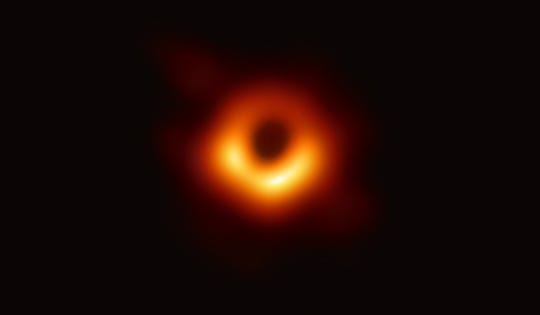
We had a great talk last Saturday at our annual U of A breakfast. Many thanks to Dr. Sam Gralla for a fascinating talk, and for introducing us to the subtleties of imaging a black hole. Thanks also to the U of A Physics Department for a delicious breakfast
Telescopes captured the first picture of a black hole.
In the talk, we learned a lot about the black hole in our galaxy and in others, especially the one in M87, which was the source of the image. Also discussed: the jet from M87, interferometry, radiation from black holes. There was a fascinating discussion of what the constructed image that was released last spring may represent, as well as what it probably doesn’t represent. We also got a sense of how much coordination and cooperation was necessary to make this extraordinary image, and also the best way to transfer terabytes of data between observatories (hint: it’s not by having a good wifi or data connection.) Dr. Grall graciously answered all questions. He also offered to share his slides, and I think I will be able to send those along soon. Thanks to everyone for coming.

Also, Fritz brought two books:
Deep Medicine: Artificial Intelligence Can make Healthcare Human Again, by Eric Topol et al.

and Something Deeply Hidden: Quantum Worlds and the Emergence of Spacetime, by Sean Carroll, whom Fritz called a “great explainer.” Both highly recommended.

Please join us for our next meeting on November 9th at J.D. Garcia’s house, with our usual format. We’ll meet at 9:00 at J.D.’s for potluck breakfast. The topic is energy. We will discuss the latest representations of energy here and in the UK, as well as when and how different instructors work it into the curriculum. Please bring your favorite demo, extra credit if it is energy-related.

Hope to see you all there.

Best,
Karie

Sunday, January 27, 2019

Meeting Notes


TAPT,

We had a fantastic and sort of nostalgic meeting last week – actually now that I look at the date it’s been two weeks. Erik Herman, former Tucsonan and founder of the Physics Factory bus, visited from Ithaca NY. He has been working as outreach coordinator for Cornell University, but is planning to go fulltime as an informal science educator. He was here to help Bruce Bayly and friends to outfit the newest Physics Bus, which seems to be bus #7. Also attending was Damien, a student who works on the bus.

The bus is small and sweet - it's the size of one of those smaller school buses that would hold about 30 students. It was purchased by funds donated by Barbara Bickel, and she was at the meeting to see the it. Bruce is planning to have undergrads drive, so the smaller size is best for that. But it had a lot of cool stuff on it: lots of wave and sound demos. One cool demo/experiment used neon bulbs in a microwave to measure the approximate wavelength of the microwaves. The bulbs are available on eBay – mine came this week. According to Al Vanuga, you can also use a compact fluorescent bulb if you put the metal part in water.

Erik’s bus in Ithaca runs on solar power. US Battery has donated some great batteries to make that possible, and they want to donate more.

One interesting discussion was about a Freakonomics podcast about supply and demand. There is a huge supply of education, but less demand. Especially science education, where there are a lot of people writing curriculum etc. Bruce and Erik see the bus as a way to increase demand for science education.

At the meeting, Fritz showed us two magazines, but I unfortunately only wrote down one: PRISM magazine, which had an article he liked on bees, and only one about cameras run by a Raspberry Pi. There was also a book: She Has Her Mother’s Laugh, by Zimmer. This is a history of the concept of heredity; it’s much more complex than we think. There is also some discussion of eugenics, which was/is bad. Fritz highly recommends this book. Also, one of Fritz’s friends invented the modem. 

In a previous meeting, we also discussed Deep Learninbg Revolution by Terrence Sejnowski. The takeaway is that people are bad at learning rules but good at spotting patterns. There was some discussion of thinking in the diffuse mode, which kind of uses the whole brain. Also, Helen pointed out that research shows that we are good at physics because we know physics. In other words, there’s not really a way to improve critical thinking without a subject matter application. I have actually been motivating my classes by using this line – you can do well at physics by learning physics.

Some dates for future meetings: 

Jim Housley will be in town for our next meeting, which is set for February 9th. Jim is planning to bring a suitcase full of equipment – if you have requests, send them to Jim at jmhousley@aol.com. Yep, he still has an aol address. In addition, I’d like to have a dinner for Jim and Karen that evening. Please put it on your calendar.

On March 2nd, the Arizona chapter of the AAPT will be meeting in Tucson at the Air and Space Museum. It should be great. I hope many from Tucson will attend – the main idea of moving the meeting to different regions of the state is to make it convenient for everyone at least occasionally.

Our April meeting is a bit up in the air, but will likely be April 13th at Pima Community College, as JD is not available on that day.

Our end of the year party will be May 18th, also subject to adjustment.

Hope to see you all in February. Let me know if you have questions/comments/suggestions.

Best,
Karie

Friday, January 20, 2017

Meeting Notes and Upcoming Dates

TAPT-ers,

We had a bunch of delicious food at our start-of-the-year meeting. Scones, muffins, cinnamon rolls – apparently no one has started their New Year diet yet.

Bruce Bayly was only one of the Brits attending. (Helen Reynolds has recently joined the teaching staff of Greenfields.) Sorry for the digression, I meant to remind everyone that Bruce has arranged for Calculus, the Musical! to be presented here next Friday, January 27, 2017. I’ll attach the flyer, or go to www.eventbrite.com/e/calculus-the-musical-tickets-30503889956 for tickets.

We had a super interesting demo by Chris Ubing. He used his I/O lab device to measure the magnetic field of a current-carrying wire. He showed how to get the 1/r dependence using loggerPro or excel graphing of B vs r.
J.D. had three things to report – he has recently submitted questions for the physics GRE, he has been interviewing Flinn scholarship applicants – quite a task since there are many and they are all outstanding – and he gave a talk on The Role of Time in Science and Religion, which we want him to reprise for TAPT.

Fritz brought a lot of books, and they might have a theme that he is very interested in, which is AI, the new electricity according to Fritz, meaning AI is as revolutionary as electricity was:
Why Information Grows, by Cesar Hidalgo. Economic growth can be treated like natural systems
The Dreams that Stuff Is Made Of, by Steven Hawking, a collection of papers or readings about modern physics.
By Michael Lewis, The Undoing Project about Daniel Kahneman and Amos Tverskyan and how they collaborated on decision theory.
Zen Flesh Zen Bones, a “collection of primary Zen sources” according to Amazon.
Lenin’s Tomb, by David Remick (historical)
The Master Algorithm:How the Quest for the Ultimate Learning Machine Will Remake Our Worldby Pedro Domingos. I guess this is the fascinating AI book mentioned at the beginning.

Steve Hoell gave a nice demo about a battery in a spring – it zips through. He found it in the January 2016 AJP I think. I’m going to try to attach a video.

Future dates:
Our next meeting is February 4th, and our friend Jim Housley will be here with some equipment. Maybe bring a bag – I know he won’t want to take it back with him.

On March 4th we will have a meeting about preparing students for the AP exams. I’m a long-time AP grader and will talk about the new exams and give some hints.

Then April 8th is the AzAAPT meeting, which will be held at the U of A in the Physics and Atmospherics building (PAS). We are working on a speaker.

We are planning our end-of-year party on May 13th, and will be twisting J.D.’s arm to talk about time in science and religion.

If you are of a mind to drive, the second annual un-conference of STEMteachersPHX is January 28, from 10 am to 1 pm at Pinnacle High School in Phoenix. I know it's far, but this is a great group. Registration is free athttps://www.eventbrite.com/e/2nd-annual-unconference-tickets-30424058177
Recertification hours are available for all meetings – I try to remember to bring forms, but an advance email is helpful.
Hope to see everyone on February 4th.

Karie
Karie Meyers, Ph.D.
Physics Instructor and Chair, Physics and Geosciences Department
Pima Community College West Campus
phone: 206-6695
office: E230
email: kameyers1@pima.edu

Thursday, January 28, 2016

Notes From Last Meeting + Upcoming Dates

TAPT,

Here are some notes from our last meeting.

We agreed to meet on February 6th at J.D.’s house so that we can see Jim Housley. Jim is a friend of TAPT from Alaska, where he is retired from physics teachers, and where he manufactures and develops physics demonstration equipment.  Jim is interested in visiting some classrooms, so if you are able to host him during the week, he would appreciate it. You can contact him atjmhousley@aol.com if you have a time that he can visit your classroom. He is especially interested in physics and physical science. I think he will be here for most of the week after February 6th, but am not sure of his travel dates.

The next meeting date after Feb. 6 is TBA – we are working on a speaker for early April.

The Festival of Books is March 12, and on that day all of the physics labs at the University are open to visitors. It’s a good day for your students to see all of the cool stuff going on there.

The Arizona section of the AAPT meets April 16th in Prescott at Embry-Riddle University.

There is a transit of Mercury on May 9 at 6:00am – 11:45. Chris Ubing is making his astronomy students come to see it as part of his final. I think we can go too, or maybe there will be some telescopes available closer to home. It’s a Monday, so I guess it would be a school day.

We will have our end-of-the-year party on May 14th

I showed some of Derrick Muller’s videos from Veritassium. He was one of the speakers at the recent AAPT meeting in New Orleans.

A website that is useful for contextual problems is: http://groups.physics.umn.edu/physed/materials.html

Fritz had been sick and had too much time to read, and he brought way too many books, but here’s a list.

The Evolution of Everything, by Matt Ridley. The title says it all.

The Swerve: How the World Became Modern, by Steven Greenblatt. It sounds great.

The Nature of Things, by Lucretius. I think this is an old one.

Wolfram Language, by Stephen Wolfram. It’s a tutorial. Several people tried to steal this at the meeting.

How to Read a Page, by I.A. Richards. Something about 100 important words.

Thing Explainer, by Randall Monroe, author of xkcd and everyone’s favorite, who also explains things in simple words in this book.

Thhe Invention of Science by David Woolton. A history of the scientific revolution.

Fritz’s illness is hard on us all. Way too much to read.

Dave Katz was nice enough to summarize his knowledge of the gem show. I have attached his hints and advice.

Next meeting: February 6th at J.D.’s house, 8:30 am. Hope to see everyone there.

Best,
Karie

Monday, October 5, 2015

Meeting Notes and Upcoming Dates

TAPT,

We had a great talk Saturday, maybe the best we’ve had, though I feel disloyal to all the other great speakers by saying so. Dr. Brad Story, who is in the Department of Speech, Language and Hearing Sciences, started with a description of talking, and went on step by step to describe how words and language are formed in the head and neck. There were a slew of amazing videos and animations made using MatLab. We discussed ventriloquists, chimps,  Neanderthals, children and teens, cows, men vs. women, and the aging voice. It was incredible, and I’m not exaggerating.  Many thanks to Dr. Story for a fascinating talk. People were bursting with questions.  If you want to know more about our speaker, you can go to the website sal.arizona.edu and find his name there. 

Also thanks to the Physics Department, who provided, through J.D., a yummy breakfast.

Fritz’s books, which we didn’t have time to hear much about:
A Beautiful Question, by Frank Wilczek, a perennial favorite author of Fritz’s
Adventures in the Anthropocene,  by Vince
Why Information Grows, by Hidalgo
Stuff Matters, by Miodownik

Our next meeting is November 14th, and I’ll let you know more in the future.

Two future events of note:
The Tucson Pumpkin Toss is October 18th on the U of A Mall. It starts early, maybe about 8:30. Spectators welcome!

The Four Corners meeting of the APS (America Physical Society is October 16th and 17th. I’ll be going on Saturday and would be happy to give anyone a ride. Here is some information from Kelli Gamez Warble, who is Teacher-In -Residence at ASU:

Hello fellow Arizona STEM teachers,

Arizona State University will host the APS 4 Corners Regional Meeting https://aps4c2015a.events.asu.edu/ on Fri-Sat, October 16-17.  There is an entire thread devoted to Education & Equity in Physics & Science, and many prominent science educators will give talks.  This includes Noah Finkelstein from CU Boulder, who will give the plenary talk entitled "Educational Transformation at a Critical Time: why us and why now--the promises of disciplinary engagement".

The registration is $65 for teachers, and waivers and CEUs are available.  A flyer listing all of the sessions involving Education & Equity can be found at this link:  https://sites.google.com/a/asu.edu/aps-4-corners-fall-2015/home

Noah Finkelstein is an amazing speaker, and it is worth the drive to Phoenix to hear him. He is a leader in the field of physics education.

Thanks to all who attended Saturday. Hope to see you all next time.


Karie

Saturday, September 5, 2015

Meeting Notes From August 29th

Tucson-Area Physics Teachers,
Here are some notes from our meeting last Saturday, Aug. 29th. Sorry to have waited this long, there aren’t quite enough hours in the day. Please feel free to let me know if I’ve left something out, there is a lot of information and my notes aren’t completely legible.
Some dates to put on your calendar:
September 26th: Fall meeting of the Arizona AAPT. This will be a really good meeting. It’s at ASU, and there are some good speakers. Bob Culbertson will talk about how ASU is changing its physics classes, and Chris Ubing will be giving a demo on the I/O take-home labs he is piloting with the University of Illinois physics education group.
October 3rdTAPT Kickoff Breakfast at the University of Arizona Physics Department. We, by which I mean J.D., are working on a speaker. Details to follow.
Future TAPT meetings are also scheduled for November 14th and December 12th. Programs to be announced, but just to tantalize you: we are trying for a report on the Ceres Dawn mission, J.D. might talk about the thermodynamics of geysers and volcanoes, DaNal will talk about Chernobyl, and we’d like to have a meeting dedicated to how people are flipping their classrooms, a lot or a little. We have more than we can fit in, so stay tuned. If you have some input and weren’t at the meeting, feel free to email me.
October 17th: There is a Star Party put on by (I think) the Cochise Amateur Astronomy group. It will be held at Kartchner Caverns! The Party starts at 1:00 with solar viewing, and I think you will be able to go into the cavern. At 5:00, U of A Professor Chris Impey will be speaking, then viewing goes into the night hours.
October 18thTHE PUMPKIN TOSS! Applications are available at TucsonPumpkinToss.org, and are being accepted now. Run by Bruce Bayly and the Physics Factory, this is a great opportunity for student participation, or just to watch the excitement on the mall. Don’t miss this!

We had a very nice meeting Saturday, with lots of lively discussion.
Many thanks to Jim Housley, friend of TAPT, who sent some demos to share. They were beautiful and awesome. If you have questions or want to talk to Jim about demos you would like to have, you can email him at jmhousley@aol.com.
Dave Katz showed the phone hack that makes your phone into a magnifier, using a cheap laser pointer lens. DaNel Hogan, who is the STEM Coordinator at the Pima County School Superintendent’s Office, had actually showed us this last year – she has a write-up on it on her website, which you should look at (http://www.stemazing.org), and you should subscribe to her newsletter, STEMAZing: Subscribe to STEMAZingYou can also join the STEMAZing group on Facebook.
DaNel Hogan and Bruce Bayly received a grant to buy some stuff that they will lend to teachers: A set of Little Bits, and a Space-time simulator, which sounds really cool,https://www.youtube.com/watch?v=DfuyZlxhrEU. Contact DaNel or Bruce if you are interested.
DaNel might be in the Ukraine now, as she was selected as part of a group to visit Chernobyl. She will give a talk on her trip to TAPT soon.
Demian Quiroz is doing the cardboard boat project that Dawn Pelayo gave a talk on last year. If you need cardboard, DaNel Hogan has a source – something about mattress sales. Contact her if you need cardboard. (DaNel.Hogan@schools.pima.gov,Tel: 520-724-8395)
If you are trying to get school supplies, people have some suggestions:
For clubs, try SupportMyClub.org.
For classroom supplies and projects: DonorsChoose.org and GoFundMe.com
I looked at all of these and they seem pretty easy to use.
Fritz’s Books: 
Birth of a Theorem – A Mathematical Adventure, by Cedric Villani.
Dirt, by William Logan. A favorite of Fritz, and 2015 is International Year of Soil, (as well as Light).
How to Bake pi, by Eugenia Cheng, also a favorite of Fritz
Life’s Engines, Falkowski, by a geochemist about how microscopic life runs the world.
Mystery of Time, by John Langone? This book, unfortunately, didn’t make it around the table, because people started reading it during the meeting, so I’m not sure of the author. A quick search on Amazon gave this version, but I’m not sure it’s the one Fritz brought – maybe he will offer more clarification, or bring it again.
Practical Criticism, by I. A. Richards. This book is about the practice of close reading, and is one of Amazon’s best books of 2015.
Let me know if you have questions or comments. Thanks to everyone who came to the meeting. 
I hope to see everyone on October 3rd, at our University of Arizona Breakfast Meeting!
Best,
Karie
Sunday, January 11, 2015

Meeting Notes for January 10th

We had a great meeting Saturday with lots of discussion.

First, some dates: We will be meeting on Feb. 14th, March 7th, and April 11th, and our end of the year party will be on May 9th.  One of the meeting programs will consist of 10-minute presentations from group members, so start thinking of something you might want to share on the topic of light, waves optics and sound - basically second-semester topics.  We are juggling speakers for the remaining dates, to be announced. Some future topics that we are still exploring: for adjunct instructors and teachers not trained in physics, what is the least amount of training needed to be an effective physics teacher? Also, organizing groups and group dynamics.


We had a few great toys and gadgets and presentations. Rob Purington showed some great mousetrap cars that his students made from scratch. He talked about the applications of physics principles that the students learn from building the cars. Alison Lemons also mention a project she assigns that is similar but with a different application of applied force: use a mousetrap to move a brick.  She will bring one of the devices to a future meeting.

Lynne Gillette presented some of the ideas that she learned at the recent AAPT meeting. Her summary is here, along with links for many of the resources.  She also mentioned the AAPT e-mentoring program, available to all new physics teachers. A link is on her handout.

Glen Linton, from Ironwood Ridge, showed an adjustable ball-bearing shooter for teaching about trajectories and vectors. And he brought biscuits and gravy!

Chris Ubing showed a lab device that he received from the Mats Selen of the smartPhysics group. It looks like a cart, but contains all the sensors that people would like to use in lab.  Here are some links that Chris sent:

The first is a link to the software used with the devices.
 http://www.labframe.org
Depending on your os, the download should be pretty straight forward. Second, there are some applications can be seen via you tube. Here is the link to the you tube channel:

 https://www.youtube.com/channel/UCkgql1ePbwyCP-selmAUJng
Third is a link to SmartPhysics.  The Smart physics site also has tutorials on how to use the device.  Here is a link to the site, but you may have to set up an account to gain access. https://www.smartphysics.com/Course?enrollmentID=67218

Fritz brought four great-looking books with very deep titles:
Our Mathematical Universe, about cosmology, by Max Tegemark
The Science of Interstellar, by Kip Thorne
The Meaning of Existence, by E.O. Wilson
The Wastewater Gardener, by Mark Nelson

I showed my partially finished underwater vehicle based on the Arduino chip.

The best toy was a helium filled, steerable Angry Bird, which Alison Lemons bought on Amazon. A motor moves along the bottom and shifts weight to steer the bird. The video is here.

Lynne also mentioned a knob that is available from Vernier that fits onto a cart and causes it to stop at the end of the track instead of rolling off the end. It’s free; just call Vernier to order.

From DaNel Hogan, some information from last meeting which I neglected to forward last time.  Here is some information about wave simulators, which we were discussing in our December meeting.

The Physics Classroom has lots of great interactives including some for standing waves.
http://www.physicsclassroom.com/Physics-Interactives/Waves-and-Sound
PhET’s newest Html5 simulator has some potential with the Wave on a String.
http://phet.colorado.edu/sims/html/wave-on-a-string/latest/wave-on-a-string_en.html
A good collection of lots of different applets for wave physics.
http://www.cabrillo.edu/~jmccullough/Applets/Applets_by_Topic/Superposition_Interference.html

I am also linking to an EM lab that includes a homopolar motor, also from DaNel. Link here.

And finally, from DaNel, here is the website for Community Share:http://www.communityshare.us/ Folks who are in the K-12 classroom should register as users and folks who are retired or in high education should register as a community partner.

I'll give more details about future meetings in the next email.

Thanks to everyone who contributed.

Karie

Sunday, December 7, 2014

December 6th Meeting Notes

TAPT - We had a very fun meeting yesterday with DaNel Hogan. Many thanks to her for her presentation. I have almost perfected the chain and loop trick. 

I am a bit short of time this weekend, but Fritz was nice enough to send me a summary of the meeting and websites that are useful, and I am attaching that below. Thanks Fritz! I notice that he did not include his book titles, so here they are:

Teaching with Problems and the Problems of Teaching, by Magdalene Lampert. Ms. Lampert was one of the originators of active learning, and much has been written about her, including a recent NYT article.

Symmetry, the Monster
Arrival of the Fittest - Fritz's second recommendation of this book. It's about biological robustness depending on the robustness of the networks that make up an organism or group..
I didn't get the name of the last book. It was about how we are polluting our water systems with sewage. Maybe Fritz can bring it again.

We meet next on January 10th at J.D.'s house for our annual toy meeting. Ask for physics toys for the holidays, then bring them to show at our meeting. We will also plan our semester at that meeting. So put it on your calendar now.

I am also attaching a sheet of information below from DaNel. She was nice enough to compile a "best of STEMAZing" for us. If you are not subscribed to the STEMAZing newsletter, you should sign up - it's a great source of support for teachers, and includes things you can use immediately in class as well as notice of upcoming events. Go to the link below to sign up.


From Fritz:

Ms. DaNel L. Hogan
Director of The STEMAZing Project
200 N. Stone Avenue
Tucson, AZ 85701

DaNel Hogan  was an Einstein fellow and likes Nuclear Energy. She also was Physics teacher in high school.

Ring with chain to drop to create a knot holding the ring.

Puzzles: (1) two paper circles taped together at right angles: make a square bigger than your face. (2) Take square, make two cuts and twist.

Pam and Chris and Mark solved it at our meeting.

Concord Consortium:  http://concord.org/


Glasses from American Paper Optics, www.holidayspec.com, www.3Dmarket.org

Dolores Gende:

SuperPi Day March 14th, 2015.

Diffusion versus Convection Confusion: The spread of a scent: You can smell it because of convection.

Homopolar Motor     
Neodymian magnet, screw, battery, wire stripped.
The tip of the screw must be on the knob of the battery and hanging straight down.
May turn up to 10,000 rpm

DaNel’s Electromagnetism lab from STEMAmazing

Recommended book:
The Physics of Christmas: From the Aerodynamics of Reindeer to the Thermodynamics of Turkey
by Roger Highfield
$14.97   Bought.

Rob’s Mousetrap Car.  Didn’t get to see it work. Would like him to make a YouTube video and send us a link.

Mentioned: Phet,  American Science Surplus in Chicago,

JD disabused me of the idea that the metaphor of metabolism is like combustion has some value.

From DaNel (Her favorite information from past newsletters):

STEM on the Cheap 
  
How would you like to be able to turn your cell phone or tablet into a close range image taking device for only $1? The image to the left shows a cell phone camera focused on the eye of Abraham Lincoln using just such a lens. Better yet, the lens you need is available in a device you can find at Family Dollar - a key chain laser pointer! Learn more about this $1 LASER pointer macro lens hack today and start taking interesting, close up pictures tomorrow! 

STEM Educator Site (Grades 6-12) 
  
What does innovation look like, and how can one generate innovative ideas in the classroom? The Design Process: From Idea to Solution collection is build around "design thinking" and is intended to help educators and learners explore the invention of real, practical solutions of some of the world's most pressing problems. 

The Design Process: From Idea to Solution collection is made up of four videos, each with an accompanying lesson plan. Young learners can watch college students from around the country engage actively with the design thinking process, and can draw inspiration from them. Teachers can use the lesson plans to easily guide their students through the design process, helping students to develop unique, innovative ideas and strategies of their very own. 

Help your students with lessons on Generating Ideas, Organizing for Innovation, Strategy Mapping and Communicating Ideas!

From NOVA Education, PBS LearningMedia and funding from the U.S. Department of Energy.

STEM Educator Site, STEM Videos
  
The Math of Energy series teaches math concepts through real-world situations that are based in the energy industry or fundamental energy relations. The series is targeted for high school students, but the concepts are valuable to viewers of many ages. The videos educate viewers about the importance of mathematics in the everyday world, especially with relation to energy topics.
 
The Math of Energy collection has a separate short video to answer each of the following questions:
  • How much coal does your cell phone use?
  • When will fossil fuels run out?
  • How much energy do you use each year?
  • How far away is the Annapurna III mountain?
  • How fast is my horse?
  • What will be the global population in 2060?
  • What is the price of gasoline around the world?
  • Is a high-speed or low-speed train more efficient?

STEM Educator Site (K-16), STEM Video
 
The mission of Understanding Science is to provide a fun, accessible, and FREE resource that accurately communicates what science is and how it really works. The process of science is exciting, but standard explanations often miss its dynamic nature. Science affects us all everyday, but people often feel cut off from science. Science is an intensely human endeavor, but may portrayals gloss over the passion, curiosity, and even rivalries and pitfalls that characterize all human ventures. Understanding Science gives users an inside look at the general principles, methods, and motivations that underlie all of science.
 
Check out the Science in Action: How Science Works video from the California Academy of Sciences explaining the process of science with an exciting new spider discovery! One of many Understanding Science Teacher Resources for K-16 educators.

STEM Educator Site (PreK-12)   
 
RAFT Idea Sheets are easy-to-use hands-on experience guides linked to core curriculum topics. Use the Idea Sheets Search Tool to rapidly pinpoint activities perfectly suited to the grade level, subject area, and content standard you want to cover. Idea Sheets are based on readily-available, low-cost materials such as cardboard tubes, bottle caps, old CD's, etc. Over 700 Idea Sheets are available for FREE!

STEM Site
  
If you are trying to teach students about the scale of the solar system, this scale model of the solar system, If the Moon Were Only 1 Pixel, is a phenomenal tool! How long does it take you to scroll out to Uranus or Saturn or the dwarf planet - Pluto If the Moon Were Only 1 Pixel?

STEM Demonstration Tool
  
Gravity Visualized is a video of physics teacher Dan Burns explaining his space-time warping demo. A 2-kg mass in the middle with rolling marbles show orbits. A large marble rolling with a smaller one next to it will mimic the Earth-Moon system. Two handfuls of marbles thrown in opposite directions will show why the survivors all go in the same direction, just like the formation of the solar system. Imagine how students from K-Gray might play-to-learn with this exceptional space-time simulator! 
 
For additional information on how to build your own, scroll down to the Spacetime Simulator section of thePretty Good Physics - Modern Physics website.


STEM Educator Site
(K-Higher Ed)
  
The Concord Consortium STEM Resource Finder features some of the best of their free, open source educational activities, models and software tools. You can search by keyword or filter by subject, grade level and type to find the right resources for your learning goals.
  
STEM Educator Site
  
PhET Interactive Simulations range in complexity from elementary to university-level and cover subjects like physics, biology, chemistry, earth science, math and cutting edge research. 
 
Check out John Travoltage to teach about static electricity or Color Vision to explore how red, green and blue light can create a rainbow of colors!


STEM Video
  
Did you know you can light a fluorescent bulb or neon tube using a plasma ball? Plasma balls are fascinating STEM toys. The Best Top 10 Plasma Ball Tricks and Demonstrations video highlights purposeful physics and physical science uses for this classic STEM toy. Explore, experiment and entertain with care while learning about electrostatics and more!